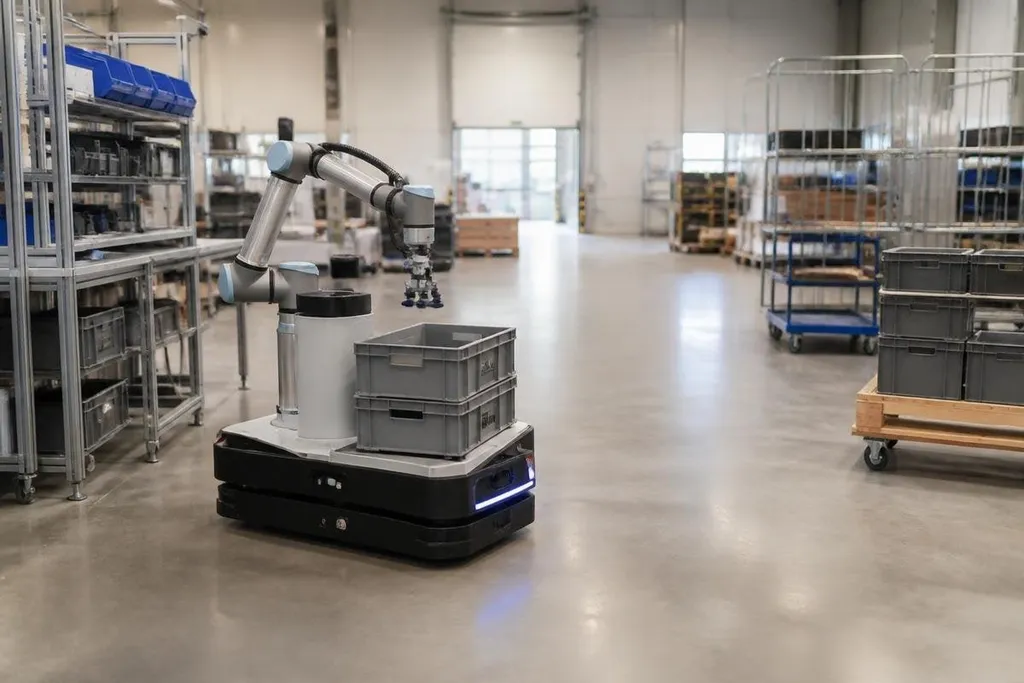
A fixed robot can repeat one task from one spot. Wheels or legs add movement, while a battery, sensors, and software help the robot travel through the work area. That change matters when the job itself moves between rooms, shelves, work cells, or outdoor points.
Quick read
- Mobile robots carry tools, parts, shelves, or inspection sensors between work areas.
- LiDAR, cameras, and maps help a robot choose a safe route around people and objects.
- The hard work starts after deployment: charging, traffic control, floor access, and recovery from errors.
Movement changes the job
A robot arm waits for an object to reach its work zone. The robot can travel to the object, perform a task, and return to a dock or another work area. That makes the robot useful for jobs where people or equipment spend time walking, driving, or waiting for parts.
The robot may carry a bin, tow a cart, move a shelf, inspect a machine, or bring a tool to a technician. The value comes from the full task: travel, work, and handoff. A fast arm still leaves a gap if a person must carry every item to it.
One platform can serve several tasks in one work area. It can carry a camera for inspection during one run, then transport parts during another run if the hardware and software support the change. The limits depend on payload, floor access, battery life, and the time needed to switch tools.
How a mobile robot finds its way
Most mobile robots combine sensors with a map of the site. LiDAR measures nearby surfaces with laser pulses, while cameras can help identify people, doors, signs, or objects. Wheel sensors track movement, though dust, slopes, and wheel slip can make that estimate less accurate.
The robot compares these inputs as it moves. If a person blocks a marked route, the robot can slow down, stop, or choose another path when its software allows that behavior. This is useful in shared spaces, but it doesn't remove the need for clear traffic rules and safe stopping distances.
A mobile robot also needs a way to recover. A blocked aisle, low battery, lost map position, or raised floor edge can stop the task. Good deployment plans define who checks the robot, how the route gets cleared, and what happens to the load after an interruption.
Recovery time changes a mobile robot’s value when staff must clear the route and reload the task. Mobile robotics reporting from Robot24.com can place that delay beside a named machine, site, route, and task before you count the work it removes.
Where the value shows up
The strongest case is a repeated movement task with a clear start and end point. A robot can take over the route while people handle work that needs judgment, repair, or direct contact with a customer.
That does not mean every site needs a mobile robot. A fixed conveyor may suit a steady route, and a trained worker may be faster when the task changes every few minutes. The robot has to fit the floor, the load, the handoff, and the safety plan already in place.
Mobile robots can also gather information while they move. A camera can inspect equipment along a route, while a sensor can record temperature or vibration. The useful question is what action follows that data. A report without a repair process adds another screen for someone to check.
Decision guide before purchase
Use this checklist when you are reviewing a mobile robot for a real site:
- Define the route: Mark the start, end, doors, lifts, ramps, and narrow points.
- Measure the load: Record the weight, size, grip method, and handoff height.
- Check the floor: Test seams, slopes, loose material, wet areas, and floor changes.
- Plan charging: Set the dock location and decide how work continues during charging.
- Set recovery steps: Name the person who handles blocked routes, faults, and lost maps.
- Count human touches: Record where staff load, unload, approve, clean, or reset the robot.
I'd skip a mobile robot when the proposed route has no repeatable task or clear handoff. Moving through a building is easy to show; completing useful work after the move is what decides the purchase.
The next test is practical: map one route, record every human touch, and check whether the robot removes a real task rather than adding another machine to supervise.